Endorecept Blood

THE FIRST NON-INVASIVE TEST TO ASSESS ENDOMETRIAL RECEPTIVITY

ENDORECEPT Blood is a non-invasive test for assessing endometrial receptivity. It is designed to determine, with high precision, the optimal day of the endometrial cycle to perform embryo transfer, by identifying the correct window of implantation through a simple blood draw.

The test is based on plasma analysis of about 300 specific biomarkers consisting of circulating microRNAs (miRNAs) involved in biological processes associated with endometrial receptivity. This approach enables the definition of a patient-specific and personalized window of implantation.

Based on the result, the physician can plan a personalized embryo transfer during the period of maximum endometrial receptivity, thereby increasing implantation probability and improving overall clinical outcomes.

miRNAs AS BIOMARKERS OF ENDOMETRIAL RECEPTIVITY

MicroRNAs (miRNAs) are small non-coding RNA molecules that modulate the expression of proteins involved in key processes of endometrial preparation for implantation, including cell adhesion and local immune modulation.

A selected set of miRNAs circulating in peripheral blood reflects the receptive state of the endometrium and can be used as biomarkers to assess the window of implantation. miRNAs act as regulatory molecules that reflect the biological processes underlying endometrial receptivity and can be measured in blood.

Micro-Rna Micro-Rna

miRNAs are “regulators” that reflect the biological processes underlying endometrial receptivity and can be isolated from blood.

miRNA expression profiles show an accuracy >95% in identifying a displaced window of implantation¹, supporting the assessment of endometrial receptivity. In particular, miRNAs are well-suited biomarkers because they:


are biologically stable compared with mRNAs, as they are protected and transported in protein complexes;

directly regulate gene expression by acting on mRNAs (translation suppression and/or degradation), and are therefore functionally linked to the protein expression landscape;

participate in implantation mechanisms, contributing to endometrial modulation and optimization of receptivity¹⁻².

In addition, circulating miRNAs can modulate pregnancy-related immune mechanisms and crucial physiological processes (cell proliferation and angiogenesis), influencing the endometrial environment and, consequently, pregnancy outcomes.

MiRNA Regulation MiRNA Regulation

1. Park H, Kim Y, Jung Y, Kim J, Kim H, Lee J, et al. Development of a Predictive Model for Optimization of Embryo Transfer Timing Using Blood-Based microRNA Expression Profile. International Journal of Molecular Sciences. 2024;25(1):76
2. Wang T, Jensen J, Li Q, et al. A novel platform for discovery of differentially expressed miRNAs in human endometrium: implications for the menstrual cycle and endometrial receptivity. Fertil Steril. 2021;115(5):1324-1334

ADVANCED TECHNOLOGY

tecnologia Endorecept Blood

The test defines the expression profile of approximately 300 miRNA biomarkers, capable of regulating more than 1,000 genes related to endometrial receptivity, using high-resolution NGS sequencing. An advanced bioinformatics workflow, supported by a dedicated computational predictor, processes the miRNA expression profile and classifies samples according to endometrial receptivity status

TEST ADVANTAGES

Non-invasive

Non-invasive

The test analyzes biomarkers in peripheral blood, avoiding the need for an endometrial biopsy, a more invasive and potentially uncomfortable procedure for the patient.

Accurate

Accurate

The analysis achieves an accuracy >95% in predicting endometrial receptivity, providing a reliable and reproducible tool to support embryo transfer planning.

Comprehensive

Comprehensive

The test evaluates approximately 300 miRNA biomarkers regulating more than 1,000 genes related to endometrial receptivity, enabling precise identification of the optimal time for embryo transfer.

TEST RESULTS

RECEPTIVE

RECEPTIVE

The miRNA expression profile is consistent with an endometrial receptive state. This indicates that the window of implantation coincides with the day of sample collection.

PRE-RECEPTIVE

PRE-RECEPTIVE

The miRNA expression profile is consistent with an endometrium at the beginning of the receptive phase. Based on the test results, full receptivity is expected to be reached after approximately 24 hours.

POST-RECEPTIVE

POST-RECEPTIVE

The miRNA expression profile is consistent with a post-receptive endometrium. The result indicates that the endometrium has already passed the receptive phase and that the window of implantation has likely ended. Based on the test results, it is recommended to advance embryo transfer by approximately 12–24 hours.

WHEN TO COLLECT SAMPLE

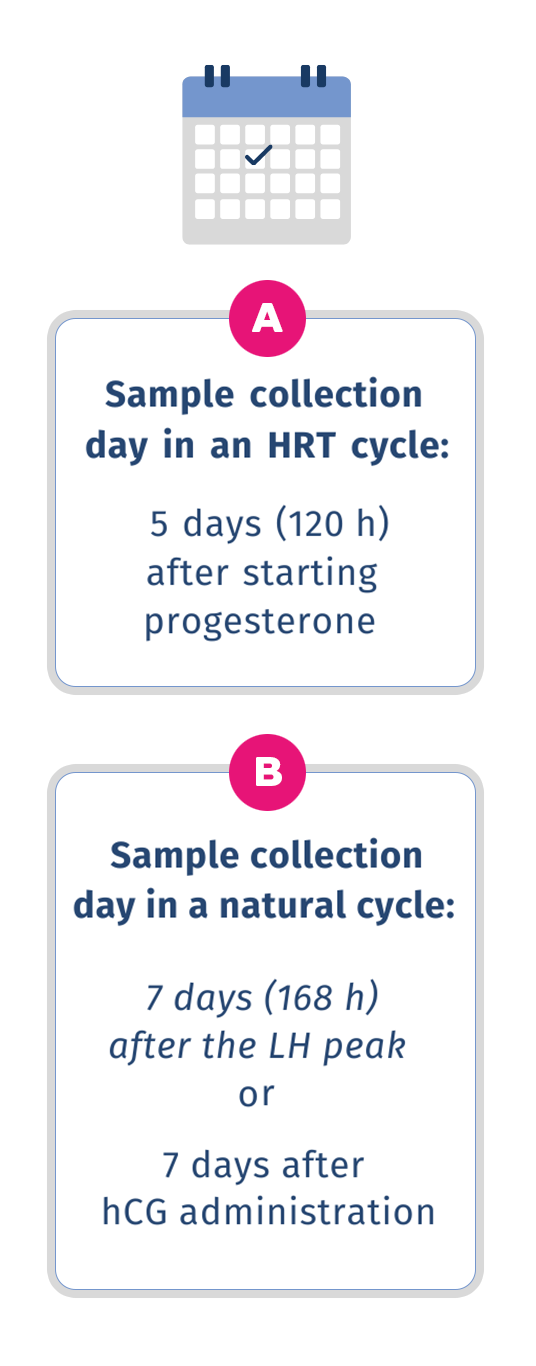
For the analysis, a peripheral blood sample is required and must be collected in a Streck tube, carefully following the instructions provided. Sample Collection Time Sample Collection Time

Endorecept

Turnaround time:
15days circa

INFORMATION REQUEST FOR ENDORECEPT TEST

Fill out this form for a free consultation.
One of our professionals will contact you, free of charge and without obligation, to provide you with all the information you need.

I have read and accept Privacy Policy